
Diagnosed at 64
Barkley
Story Written by Self
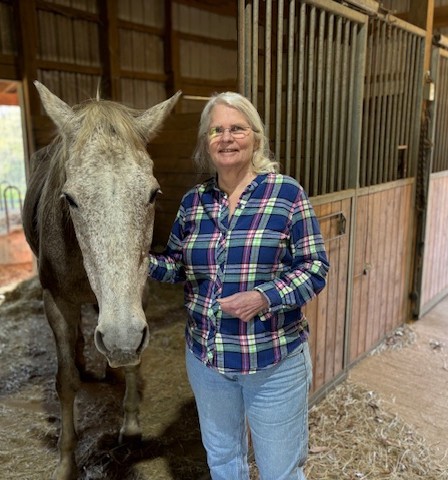 My story started, I thought, when my nurse practitioner (NP) noticed my right leg weakness during what she referred to as a ‘mini physical’. I hadn’t seen her in a few years —as I am not a fan of doctors —which seems silly looking back. She ordered a CT scan, which I had done the next day in our small-town hospital.
I brought my husband to my follow-up appointment to hear the results. The NP went on and on about the bloodwork and bone density test results. Finally, she said, “You might want to see a neurologist or neurosurgeon in the next 6 months or so.” She went on to explain why —which we quickly realized was ill-informed.
Luckily, my husband asked for a copy of the report, and we went home to figure out what condition shared the initials with Neil Patrick Harris. It didn’t take us long to figure out that we needed a neurosurgeon —and waiting 6 months would not be ideal. Yesterday would’ve been better!
I’m fortunate to have a friend with an incredible network of specialists. I called her and said, “So, Molly, know of any good neurosurgeons?” She did. While on the phone with her, my husband was doing his own research online —and when I hung up, we had both landed on the same name! We were able to get an appointment for the following week, just after a holiday weekend.
The neurosurgeon reviewed the CT scan, while his Physician assistant (PA) ran a few tests on me. We walked in to meet with him, it took less than 5 minutes for him to say “Well, I can order you a lumbar puncture (LP), to prove to you that you have normal pressure hydrocephalus (NPH), or you can look at your scan with me —I have room in my schedule for shunt surgery next week. Which would you prefer?”
I chose surgery the following week. This was in July of 2019. By the time I got to my hospital room from recovery, my walking had already improved, and the incontinence was gone.
I needed a couple of shunt adjustments over the next eight weeks. Eventually, the neurosurgeon said, “You’re good to go —call me if you need anything!” Well, that was a surprise!
Ten months later, I called because my symptoms were returning. I had one setting left to try — and it worked for three and a half years. During that time, my neurosurgeon retired due to his own injury. I realized I needed to find a new neurosurgeon, just in case.
I found one not far from my rural home. He assured me that he was familiar with hydrocephalus and shunt systems —but he didn’t follow up at all. Not my cup of tea. I decided to go to the best.
After a shunt tap, it was determined that my valve was starting to fail. I had a revision on my valve only and the addition of a gravitational device in October of 2023. More adjustments were needed to get back to how I was feeling after the shunt tap. Unfortunately, that never happened.
About six months later, I began experiencing what I thought was just a stitch in my side. I underwent many tests — but left out neurological tests, assuming it couldn’t be an issue with the distal catheter again so soon. Eventually, I had an abdominal MRI, which was read by a very skilled radiologist. It revealed that I had a pseudocyst near my liver, caused by the distal catheter.
Getting the attention of my well-known neurosurgeon a couple of days before Thanksgiving was impossible. My husband took me to the emergency room (ER) at his hospital. Fourteen hours later, at 4:00 a.m. on Thanksgiving morning, the distal catheter was externalized at the bedside in neuro-critical care. The next day, after numerous inconclusive tests, it was assumed that I had a shunt infection, and the entire shunt system was removed.
I was discharged home with a PICC line for penicillin for two weeks. A few days after finishing the antibiotic, I returned to the hospital for pre-operative testing. My neurosurgeon wasn’t thrilled about the results, but after consulting with infectious disease, he agreed to replace the entire shunt system.
By then, all of my symptoms had returned. I was very worried about falling, even though I was using a cane in my house. The other symptoms were also quite unpleasant.
In hindsight, I realized that the falls I experienced and the urgency to rush to the bathroom —while lurching from place to place —were all symptoms of NPH. I also struggled with issues related to awareness and thinking. My husband had to stop me when we got to an intersection so I wouldn’t keep walking into the street. Being unable to respond quickly to a question from my 85-year-old stepmother was another sign of NPH. The symptoms began about two years before I was finally forced to see the NP for completely unrelated reasons.
Along the way, we discovered that the right leg weakness was actually due to Primary Progressive Multiple Sclerosis. That diagnosis also explained the scalp and facial pain I had originally mentioned to my well-known neurosurgeon. I’ve also since been diagnosed with trigeminal neuralgia.
For someone who wasn’t a fan of doctors, I now have my own phone book of specialists. Best wishes to everyone on this journey.
Tell us about your journey with hydrocephalus!
Share your story of hope and perseverance with us! We will feature the amazing individuals in our community who are living life to the fullest regardless of their condition! Stories are reviewed by our staff and posted on our website and through social media. Stories should be no more than 800 words long. Click here to submit your story today!
Let’s SHARE. Let’s CONNECT. Let’s raise AWARENESS! Let’s INSPIRE!
For questions, email: info@hydroassoc.org with the subject line “Share Your Story”.